Pergasha's Locations
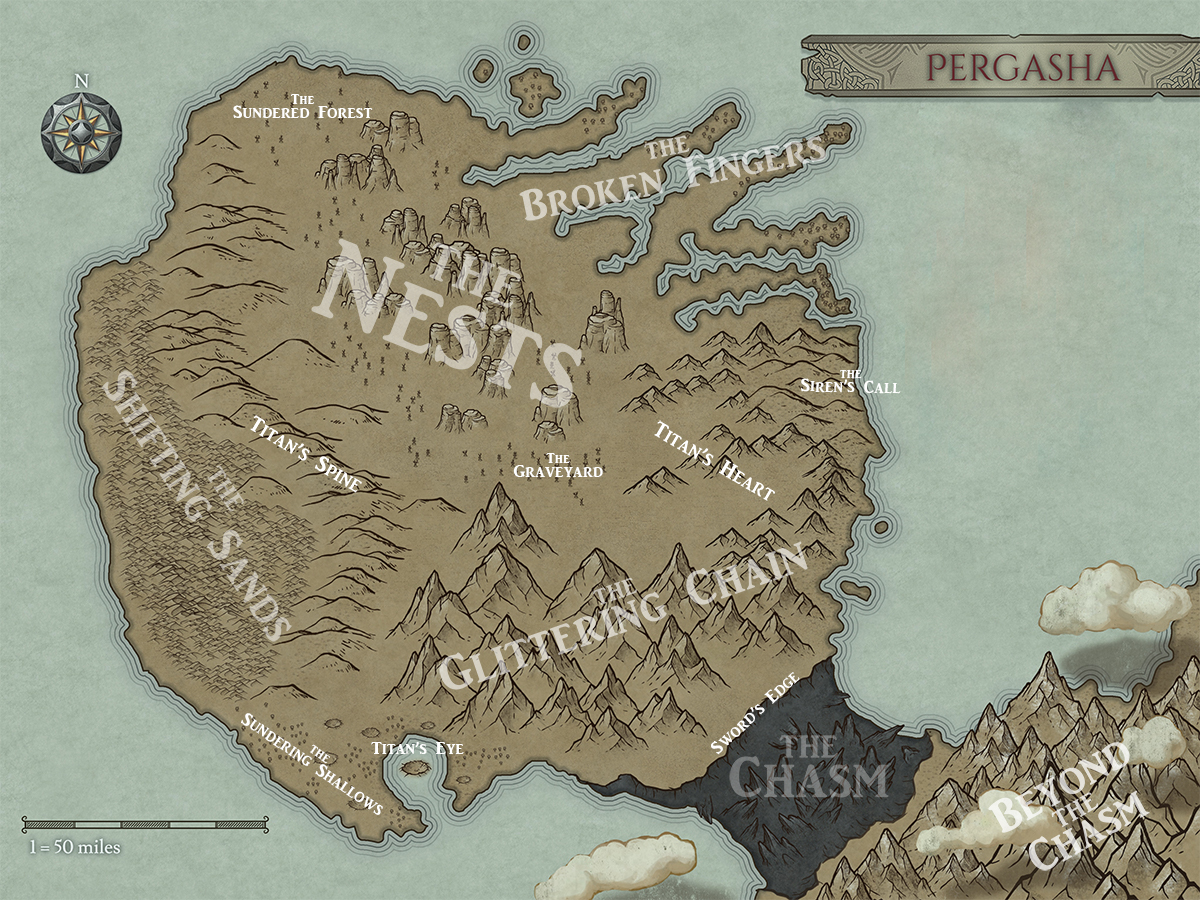
Beyond the Chasm
Tall, imposing mountains await those who survive the Chasm. The dwarven kingdom of Torhelm are staunch guardians that attack anyone who dares to cross over and enter Kanishe. With the resources from the humans of the Eleven Elders and the magic from the elves of Mairea Dor, the people of Pergasha avoid any attempts to cross. Unless there is a Great Flood. But that’s another story.
The Broken Fingers
A series of jagged peninsulas were carved out during the Sundering, turning a once lush, tropical coast into dank, quicksand-ridden fragments. Despite this, the Broken Fingers are rife with pockets of almost-potable water, odd herbs, roots and spices grow abundantly, and the low hills. The presence of water makes this a hotspot for all manner of dangerous creatures. The land is difficult to build upon, and evidence suggests that the water is slowly claiming the Fingers.
Denizens. Dozens of Lizardfolk tribes roam these lands as their ancestors once
ruled the tropics. Anyone venturing near the tips of the peninsulas will be hard-pressed to avoid meeting
any of these private survivalists. Some of the more traveled Lizardfolk reside inland and down the
southeastern coast by Siren’s Call to meet with trade caravans.
Additionally, many clans of Storm Pergashans sojourn in this region. The Storm Pergashans search for relics
and their lost, underwater kingdoms, and some have built buoys and small rafts to carry them out to the
islands to the northern most ends of the Fingers. These islands have many natural resources, but toxic winds
blow in from the ocean seasonally, making the islands uninhabitable for much of the year.
Dangers. Disease, eating something poisonous, and being eaten by amphibious amalgamates that venture out of the water are common dangers in the Broken Fingers. Additionally, creatures are more aggressive and territorial due to the dwindling resources. One could easily lose footing and find themselves drowning in marshy, boggy quicksand, or get lost in a storm that drops suddenly without warning.
Resources. Medicinal herbs and fungi, many rare spices, fish, large harvestable creatures, and natural sources of potable water are available in the Broken Fingers.
The Chasm
The Chasm is nearly 150 miles across and over a mile deep. Jagged rocks create a dangerous maze that hides monstrous beasts and aberrations. The ocean on either side of the Chasm is held at bay by an unknown energy source similar to a force field. The sight is terrifying: a wall of water a mile high, swirling and undulating against the fields, sometimes splashing over this invisible wall, all while presenting the dark, eerie secrets of the ocean depths. Massive creatures of the oceans sometimes pass by, curious, while others bash themselves against the walls, challenging its strength.
The Great Flood. The ocean walls of the Chasm have failed multiple times over the years. There is no explanation, but when the force fields collapse, the ocean crashes into the Chasm and often causes what the Pergashans call the Great Floods or High Waters. Sometimes, the flooding is so severe, much of the Pergashan peninsula is under water. When the floods finally recede, hidden technology, ruins, and treasures are revealed or left behind.
Adventuring the Chasm. The dry interior of the Chasm grows darker the lower one
descends. Terrors live in this rocky corridor, their shrieks and calls sometimes echoing loud enough for the
vibrations to be felt like an earthquake near the Sword’s Edge above. In the early days after the Sundering,
the people tried to pass the Chasm to seek refuge.
Survivors, what few there were, returned to the
desert telling haunting tales of ghosts, the living dead, and moving stone. Deadly flash floods rush through
the Chasm without warning, tearing anyone and anything with them. Some brought back incredible relics,
glittering gems, and technology not ever seen before, encouraging would-be treasure hunters to try their
luck. It became clear that it was safer to live in the desert with its Sundering Storms and gargantuan
worms.
The Glittering Chain
This mountain chain boasts the highest peaks in Pergasha. The cold, arid mountains house treasures within its barren exterior. There are underground networks that house some of the few cities in Pergasha.
Denizens. Gems, psi-crystals, and metal ore are abundant for those that can handle darkness, poor air quality, and beasts that stalk its prey for miles. Stone and Gem Pergashans often dwell near or within the Chain. Fire Pergashans make frequent visits to trade for ore.
Dangers. Traveling the cold exterior of the Glittering Chain is a unique challenge
in Pergasha. In addition to hypothermia, rockslides and flash flooding are common. Massive
rock-biters—armored worms with teeth hard as diamonds—chew their way through the mountains as easily as a
fish swims through water, and the eerie groans that echo through the canyons are thought to be the spirits
of the dead.
Dangers within the caverns of the Glittering Chain are similar and different. Cave-ins,
floods, and rock-biter intrusions are common hazards. Living too long underground, however, can have
deleterious effects on the body. Kipsum, a phosphorescent mineral that builds up on damp stones in caverns,
is abundant in the Glittering Chain. This mineral creates a toxic gas when it comes into direct sunlight
that lingers for weeks.
Resources. In addition to metal ore, precious gems, and historical artifacts, psi-crystals, mysteriums and impressive relics have been found in the Glittering Chain. Kipsum also has been used to make interesting, effervescent beverages, and spelunkers have found large doppelkin geodes beneath crusts of this mineral.
Adamant Falls. One of the largest settlements known, Adamant Falls is
carved into phosphorescent cavern walls located near an underground river. This river is called Sleepy Run
which is a bit of a misnomer as the river eventually grows turbulent and violently sheds off into a massive
waterfall. The waters from this river are fed from an enclosed lake in addition to snowmelt from the
Glittering Chain.
Gaps in the stone walls and ceilings allow spurts of sunlight, enabling unusual
moss and flora to thrive. The sunlight also reflects scintillating colors off the gems, metal ore, and
psi-crystals embedded into the caverns. Adamant Falls is the home of many Stone, Gem, and Fire Pergashans
and is a popular stop for drifters and travelers. The settlement has been washed away by the Great Floods
that bleed through the Glittering Chain through the Chasm, only to be rebuilt upon the bodies of those too
afraid to traverse the desert.
Lustran. This settlement is built on the remnants of what was clearly once a proper, great city. Lustran comprises of about three miles of tunnels that open to an immense cavern where Stone and Gem Pergashans, various scholars, and masterful crafters have made their home. This core of Lustran displays beautiful marble arches and pillars erected long ago. The walls and structures are painted with vibrant colors and adorned with masterwork sculptures, some new, some ancient. Who built the original city is unknown, but the monk scholars known as the Delvers have protected this site as it is one of the few known places in Pergasha to have written texts, scrolls, and even remnants of books.
The Graveyard
The Graveyard is a dried basin set in the lowest elevation of Pergasha. It can be
unbearably hot in this region especially with its lack of wind. While its name is ominous, the Graveyard is
valuable because the floods have deposited many relics and mysteriums in the area.
When the region
gets an abundance of water either through flooding or a rare wet season, the Graveyard transforms. Flora
bloom in an array of colors for miles, attracting many people and creatures.
Denizens. Fire and Sand Pergashan clans live on the outskirts of the Graveyard where the heat is less severe. Otherwise, most avoid the Graveyard due to the high heat. Drifters and travelers often opt to go around rather than the most expedient path, but sometimes the promise of buried relics is too strong a lure.
Dangers. Few things survive in such intense, arid heat. The Graveyard is part of an underground migration path between the Titan’s Eye and The Nests for magwyrms, insectoid-shaped creatures that are partly made of magma. While the magwyrms themselves are not aggressive, they slice tunnels as they travel which causes instability in the land above that can lead to massive, deadly sinkholes. And when provoked, magwyrms will not hesitate to defend themselves by spewing their magma innards at enemies.
Resources. The grisly truth is that scavengers do well in the Graveyard. Clans and
caravans that die trying to cross leave behind their worldly possessions. Treasure hunters look for
mysteriums and relics, and intrepid delvers enter sink holes in search for secrets.
Despite the
heat, some wildlife exists in the Graveyard. A variety of cacti, some so massive, they look like trees,
bloom fragrant flowers that attract insects, and both the insects and the flowers have medicinal properties.
The cacti are also the rare sources of water. Flakes of transparent, glass-like stone are scattered across
the sandy fields. These stone flakes are of an unknown origin and make excellent weapons. Fire Pergashans
have been experimenting with this stone to understand its properties and have named it Starflint.
The Nests
Set at low elevation in central Pergasha, the Nests are comprised of rust and crimson mesas jutting out of the land. The Nests have the largest towns and number of sedentary clans because of the milder temperatures and natural environment. Structures are built into the sides of the mesas and reach below the surface into natural and artificial caverns to benefit from cooler conditions. Flying creatures and Feathered Kin make their homes higher on the mesas, giving the area its name.
Denizens. This region is popular location with Cloud and Stone Pergashans in addition to Feathered Kin. Cloud Pergashans have built sky bridges and ladders to reach the tops of mesas, greatly expanding their reach in the region. Stone Pergashans have concentrated themselves in the cooler caverns, expanding a network of tunnels to create a large underground city.
Dangers. Sundering storms strike the northern shores frequently, and the larger
storms often affect those in Tyr’s Reach. When a storm looks especially dangerous, Cloud Pergashans go for
the lower areas of the mesas to hide within stone walls.
The central region of The Nests is the home
to some of the largest flying dinosaurs in all of Pergasha. They can be especially aggressive during mating
season, and they will not hesitate to make a snack out of a careless Pergashan.
Magwyrms live deep
underground throughout the area during the hot season to feed on stone and mate. Often, the holes left in
their feeding frenzies get filled by the waste products of other wyrms, so sinkholes are less frequent but
not unheard of. There is a tale of an entire mesa being lost because of a particularly voracious
magwyrm.
The higher one goes in the mesas, the stronger the winds. Gusts are more dangerous as they
can surprise even the steadiest, most sure-footed individual.
Resources. Magwyrm waste, called klaar, has many uses. Fresh, it is mostly
magma-like and can be used to smelt ore quickly and carve into rock if used carefully. It stays in a
semi-solid state for months and is used to keep the chilly peaks more comfortable softly alight. As klaar
begins to harden, it darkens, and its crust can used similarly as charcoal. In its completely cooled state,
which generally takes over a year to be reached, klaar becomes hupak, a dense stone useful for weapons,
tools, and construction.
In addition to klaar and hupak, colorful pigments, minerals, and chalks are
abundant. A fragrant spice called apik, akin to capers and peppers, grows from the crevices of the mesas and
drapes down its walls.
Beneath the mesas, the underground river that runs through Q’rac is the site
of many fungi, mosses, and grubs. The fresh water and the access to cooler temperatures allows for some
farming when enriched soil is available.
The Rainbow Road is a bustling trading zone where almost
anything you need (or want) is likely to be found.
Hightown. The Feathered Kin have slowly and meticulously crafted their sky
kingdom at the tops of the mesas. With the help of their Spiderling brethren, Feathered Kin created a city
woven together in a beautiful array of colors. Silks, feathers, colorful glass, and other reflective or
shiny materials are knitted from one peak to another to form bridges, nest-like structures, and beautiful
swings. Hightown is a free, open space for people to gather, share songs and stories, and live
harmoniously.
Long rope ladders are available to invite walkers or non-flying friends to Hightown,
but visitors and locals alike must adhere to strict rules of non-violence and fire prohibition. Because the
city is made with highly flammable materials, no one can bring flame to Hightown. Doing so comes with the
immediate sentence of being thrown from a peak with bound wings.
Hightown is defended by a rotation
of guards, and these guards are the only ones allowed to use violence in the area. Large birds or flying
reptiles sometimes make attempts at hunting, but the guards use ballistae and nets to keep the denizens
safe.
The city’s leadership is constantly flowing and shifting much like the guard. Each season, a
new king or queen (or “Song”) is chosen by the winds. Contenders begin to sing, and denizens of Hightower
choose a leader by following him or her in the song. The event can take days, waiting for contenders to drop
out or their songs get lost in the din.Some contenders have died from exhaustion, but never has a leader won
through violence. The king or queen of Hightown helps organize Peak Elders—the heads of each high point of
the city—guide building projects, negotiates trade agreements with caravans, and is the representative to
the Pergashan Tribunal when needed.
Those that live below dense areas of Hightown often enjoy the art
reflecting colors and light across the canyon as well as the tinkling of chimes and music echoing down the
mesa walls.
Q’rac. This sprawling underground city is the pride of the Stone Tribe.
Thanks to the readily available pigments in the mesas, artisans have created a vibrant, beautiful home
beneath the hard, hot ground. Q’rac is accessible through guarded entrances at varying levels of the mesas
that form Tyr’s Reach, some secret, some in plain view.
Individual clans within the Stone Tribe
prefer to keep their distance from each other. After all, they are a private people that prefer solitude to
tap into their minds and creativity. Parts of Q’rac are almost chilly as the city reaches deep below and
eventually is divided by a wide underground river. The river is called Fenris, named for the claw-like shape
of its tributaries. Bridges connect the divided areas, special symbols mark the walls to help with
navigation to those who can interpret them, and it is hard to say just how far this underground system
runs.
The Stone Tribe works closely with a group formed primarily of curious but secretive monks
called the Delvers to help excavate and study ruins found underground. Together, they protect the secrets
and natural beauty of the city. Despite the abundance of precious gems and psi-crystals found in its depths,
Q’rac is a place known for its treasures left untapped. Those who have been granted visitation to see the
deeper, protected areas describe it as a hauntingly beautiful but untouchable place where the past is
preserved in crystalline perfection.
Rainbow Road. The grounds below Hightown are populated with walkers or
those without flight. The area is transient with drifters and travelers temporarily setting shop as a
layover before moving on to find more supplies. However, some have made a permanent home beneath the beauty
of Hightown and made an almost equally beautiful reflection upon the hard earth.
To enable ease for
travelers with wagons, the people have created a 10-mile long road with stones. It may not be a perfectly
smooth road, but it is the only road known in all of Pergasha. Using pigments found in the region, the
stones of the road and the mesa walls on either side are chalked in brilliant colors. The residents
regularly recolor the fading pigments and take great pride in their road. Deliberately harming the road is a
vile act in this settlement and is harshly punished. Visitors who plan to stay a while are expected to offer
supplies for the road or help with continuing its construction.
Residents use stone and mud to build
homes out from the mesa walls, using natural openings or caves to expand their homes underground. This helps
keep their homes cool, and clever channeling of the caves helps bring the cooler air to the road itself.
Tyr’s Reach. Located in the northern region of The Nests, Tyr’s Reach is
comprised of the five tallest mesas in the area and is the stronghold of the majority of the Cloud Tribe.
These mesas look over the Sundered Forest and the northern seas, and each mesa is connected to the others
via incredible skybridges and flyropes. Flyropes are strong cables that enable fast travel from higher areas
to lower ones by gliding down on special handles and harnesses. The lower elevations of these five mesas
have openings that lead into the stony mesas, and Stone Pergashans have carved staircases to lead deep below
to their own settlement called Q’rac.
There are often small skirmishes between Cloud clans, each clan
seeking to claim higher ground on the mesas. The higher one’s clan resides, the greater prestige and power.
Despite these skirmishes, the tribe unites to stand watch over the skies for enemies and incoming
storms.
Storm Pergashans clans that focus on storm chasing in the Sundered Forest travel to Tyr’s
Reach to restock, trade, and recuperate. As such, they have a close relationship with the clans of this
region and often intermarry.
A few Gem Pergashan clans, especially those interested in scholarly
study of ruins, also make their home in Tyr’s Reach as well as Q’rac. They lend their psionic prowess and
precious materials in exchange for protection and freedom to pass between the heights of Tyr’s Reach and the
depths of Q’rac without question.
The Shifting Sands
This western region of Pergasha is lined with trails of dunes as winds push the fine sands against the inland mountain range known as the Titan’s Spine. Priceless oases are spread across the region but finding them is treacherous. The landscape can literally change overnight as miles of dunes are drawn in like whirlpools and transferred to a different area of the region. This chaotic landscape can make one go from riches to rags—or worse—in the blink of an eye. Sometimes, oases linger for seasons, making it a great gamble with great rewards to remain for extended periods.
Denizens. Nomadic Sand Pergashans reside in the Shifting Sands, taking their tent and caravan villages from one oasis to another. The area is also known to be the favored hideouts for bandit gangs and the burgeoning Touched Kin tribe. Merchant groups and drifters take great care to find open oases, gather as much as they can, and move on to continue with trade.
Dangers. Because of oasis looting, bandits are spread throughout the Sands. Powerful sandstorms occur frequently and grow into Sundering Storms with lightning and mind-affecting howls in the right conditions. Great sand serpents and worms rule the area, swimming through the sands as though they were water.
Resources. The massive oases—some, multiple miles in diameter—house lush greenery, pristine waters, exotic fruit, and rare spices like saffron and vanilla. Beyond the oases, the sandstorms can uncover ancient ruins, massive relics, and mysteriums of great power. And along the coast, salt fields provide most of the peninsula’s supply of the precious preservative and seasoning.
Siren's Call - WIP
Denizens. Lizardfolk. Storm Pergashans also reside here to search for underwater cities.
Dangers. Tsunamis and seasonally bad weather, but otherwise one of the nicer places to be.
Resources. Pinion, salt, game, fish.
The Sundered Forest - WIP
The trees are not exactly living. Sundering Storms have touched down here hard before tearing through the central peninsula.
Denizens. Storm Pergashan clans that focus on storm chasing live here.
Dangers. Abundant storms, mental effects.
Resources. Petrified wood, blue glass made when sundering lightning strikes.
The Sundering Shallows - WIP
These lowlands are littered with black sand and craters. Doppelkin geodes, psi-crystals and other oddities are found here.
Denizens. Many Gem Pergashan clans have ventured out of their underground homes to find psi-crystals in this area.
Dangers. Bad air, geysers, poisonous creatures.
Resources. Sulfur, minerals, creatures to harvest. Psi-crystals and geodes.
Sword's Edge
People once settled here after the Sundering. It suffers the least from storms and the land is more fertile. Then the First Great Flood wiped everyone out. This area is only traversed through when attempting to enter the Chasm.
Titan's Spine - WIP
These windy hills separate the Shifting Sands from the rest of the peninsula. Canyons throughout and vibrant colored stone.
Denizens. Stone and Cloud Pergashans reside here.
Dangers. Home to dinosaur-like creatures and rock worms.
Resources. Pigments, minerals, precious metals, herbs and grasses, creatures to tame.
Titan's Heart - WIP
Two valleys with moderate heat. It’s a rain shadow area with some basins that allow abundant flora and fauna. People generally stay at Siren’s Call and the nearby mountains in the hot season and venture down into the valley for the cooler season to take advantage of the abundance.
Dangers. Other people fighting to take what is yours.
Resources. Pinion, nuts, herbs, game, large quail and cassowary eggs, cacti with unusual fluid.
Titan's Eye - WIP
This crater is an active volcano in the middle of a bay.
Denizens. Fire and Storm Pergashans have found a way to eke out an existence in this sulfuric region.
Dangers. The volcano, toxic food and water. The volcano.
Resources. Magwyrms nest here. Obsidian is abundant as well.